
Stephanie Urbina Jones
MANUEL’S DESTINY BIOGRAPHY
Like a bird in the sky with his heart open wide
And the faith to fly
Like an unbridled horse on an uncharted course to a better life
With hope in his soul his Corazón made of gold
He believed he could do anything
That was the story they told when I left home at twenty years old
“Manuel’s Destiny”– Stephanie Urbina Jones
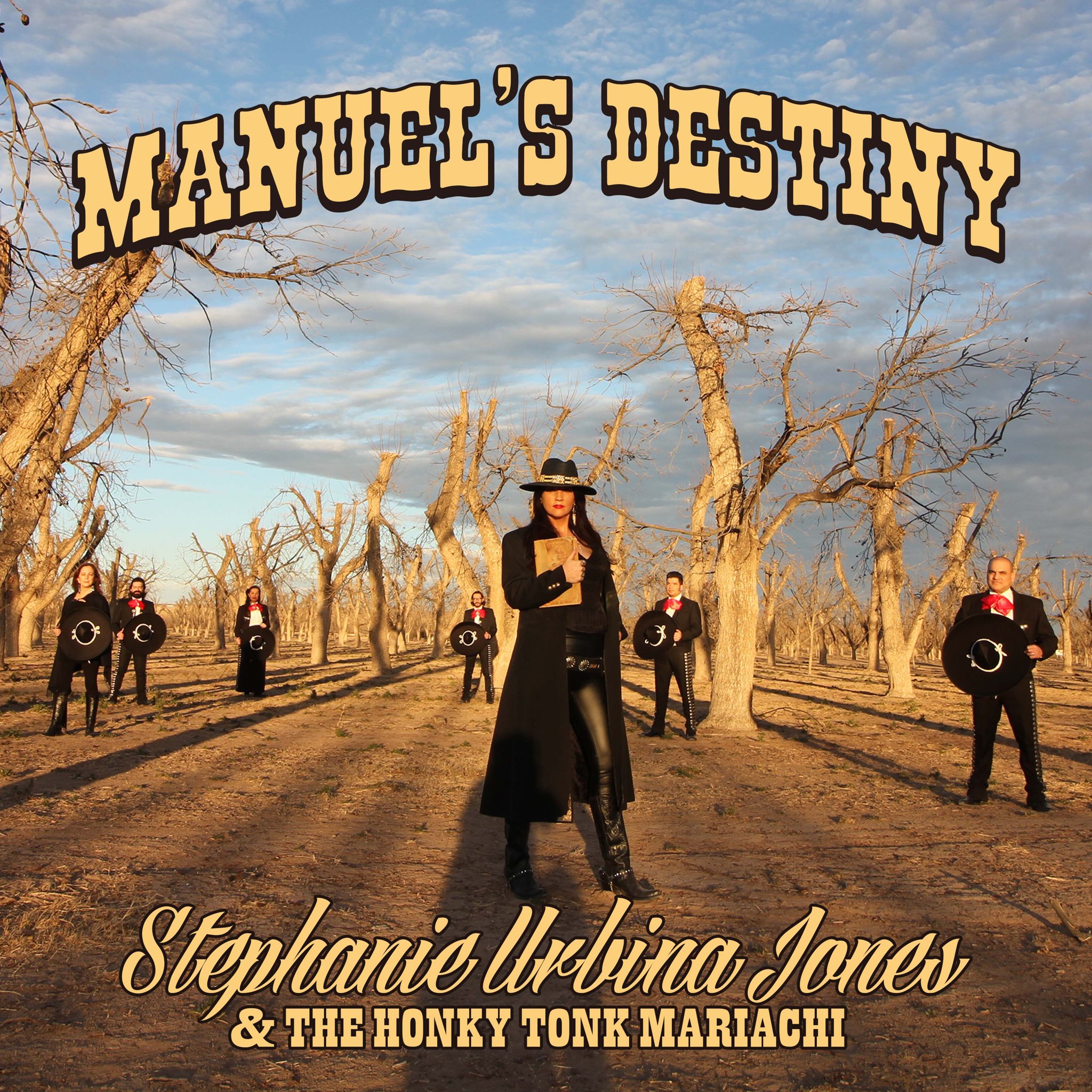
The latest offering from Stephanie Urbina Jones & The Honky Tonk Mariachi, Manuel’s Destiny, goes far beyond the limits of the typical album: it’s a saga, a joyride, an impassioned reclamation of her cultural heritage, and—above all—a riveting tribute to the power of a dream to travel over 100 years and three generations. From her great-grandfather crossing the border, to an artist living and telling a transcendent story, and ultimately living Manuel’s Destiny.
Over the course of 11 wildly dazzling songs, the Texas-bred, Nashville/Mexico-based singer/songwriter sets her storytelling to a one-of-a-kind sound she’s created and calls “Honky Tonk Mariachi”—a gorgeously orchestrated fusion of her Mexican roots and San Antonio, TX Hill Country upbringing, centered in the stunning vocal prowess she’s shown in touring across the globe, sharing the stage with legends like Willie Nelson, and making history as the first artist ever to perform with mariachi at the Grand Ole Opry. The result is the most revelatory work yet from a truly visionary artist, one that leaves the listener newly emboldened to fearlessly follow their hearts and live a dreamer’s tale.
For Urbina Jones, the making of such an ambitious and all-encompassing album took decades of soul-searching and careful excavation of her family’s history. Originally from San Antonio, she spent much of her early childhood at backyard barbecues at the home of her paternal grandmother, where she first heard the traditional Mexican music, she now describes as “a transmission of pure joy and love.” When her parents divorced, Jones moved to a small town in Texas, and as a young girl, frequented local honky-tonks, two-stepping to songs by all the country greats and listening to poets like Jerry Jeff Walker, Guy Clark, and Townes Van Zant carve out songs by the potbelly stove in Luckenbach, TX. (“Margie the bartender was my babysitter. I got to put the sawdust on the floors,” she recalls). But despite her many happy memories, that period of Urbina Jones’ life also carried a heavy burden of pain. “After I was pulled away from my father, I was told to hide the fact that I was Mexican, which haunted me for a very long time,” she says. At age 18, however, Urbina Jones made her first trip to Mexico (accompanied by her father) and immediately felt a profound sense of revelation. “I fell madly in love with my culture—the people, the music, the food,” she says. “I finally realized, ‘This is who I am.’ From this moment on, the direction of my life changed. I became passionate about telling a new story celebrating my roots. My pain turned into my passion and purpose.”
As she unraveled her family’s history, Urbina Jones learned of her great-grandfather, Manuel Anaya Urbina: a Mapimí, Hidalgo, Mexico native who went to the Vatican to study for the priesthood in the late 1800s. After two years in Rome, he rejected his childhood religion. “He returned to Mexico and crossed into El Paso in 1907— left his country, left his family, left his faith, left everything to embark on a new life for his own personal freedom,” she says. “He ended up becoming the first Mexican Baptist minister in San Antonio and spread the gospel all over the Southwest. Once I discovered his story, I became passionate about the idea of this dreamer crossing the border to follow his heart. I feel as if his dream has lived on through me, and now I want to share it as a source of inspiration for anyone seeking their own divine truth.”
The follow-up to 2018’s Tularosa (a powerhouse album stacked with mariachi-infused covers of country classics like “Ring of Fire” and “Jolene”), Manuel’s Destiny finds Urbina Jones moving forward with her mission of introducing audiences everywhere to the unbridled passion and heart of Mexico. “As a little girl growing up listening to mariachi, the joyful sound of their voices singing together always felt like an instrument in itself, and I knew from the start that I wanted that to be woven into every song on this album,” she says. Produced by Urbina Jones and Preston Sullivan, and recorded live at Sonic Ranch in Tornillo, Texas—not far from where her great-grandfather crossed into El Paso—Manuel’s Destiny achieves its lush and fiery sound thanks to contributions from over a dozen musicians, including guitarrón player Mike Hernandez (also the album’s mariachi session leader), Urbina Jones’ bandleader/longtime guitarist Patterson Barrett, and a lineup of esteemed mariachi players from all over Texas, Nashville, Los Angeles, and Mexico. With its resplendent selection of heart-on-sleeve ballads, hip-swinging Texican Americana anthems, and pedal steel-laced country- rock songs, Manuel’s Destiny ultimately radiates an electrifying energy, adding even greater impact to the countless pieces of wisdom woven into her lyrics.
In many ways a document of Urbina Jones’ own whirlwind adventures in fulfilling her life’s purpose, Manuel’s Destiny opens on “Gypsy Dreams”—a fierce yet euphoric refusal to tame her free-spirited nature. “It took me a long time to honor who I was born to be — an artist, a dreamer and author of my own life. I’m gratefully reclaiming and sharing my joy with the world,” says Urbina Jones.
Ever since she was a little girl, she’s always been this way.
You can be part of her world, but you can never make her change. (“Gypsy Dreams”)
On the album’s cinematic title track, meanwhile, Urbina Jones opens by recounting her great-grandfather’s pilgrimage to the States in search of his truth and divinity, then looks back on her own leap of faith in leaving home to follow her heart and one day live the spellbinding epic, which is “Manuel’s Destiny:”
I got in my car with my Spanish guitar bound for Tennessee,
As I drove through my fear, I felt his spirit near guiding me,
I was strong, I was able, I waited on tables, said yes sir, no m’am, cause I knew I’d get the chance for my dreams to dance and do what I was born to do.
Wendy Moten, a multi-talented Memphis-born singer, and another dreamer whose voice and career path are like no other, joins in for a triumphant update of Glen Campbell’s iconic “Rhinestone Cowboy” (with a blessing from songwriter Larry Weiss on the cover’s gender flip). Built on a near-symphonic arrangement of soaring violins, exultant trumpets, vihuela, and heavenly harp, “Rhinestone Cowgirl” emerges as a powerful account of overcoming the odds on the way to unfettered glory. “Both Wendy and I have been relentless in becoming who we were destined to be,” says Urbina Jones. “The fact that a Latina and a Black woman are stepping into this moment and singing this classic song together is incredibly meaningful to me—we’re representing all dreamers of all ages, from all backgrounds, and hopefully encouraging them to bravely answer the calling of their own hearts.”
On songs like “Falling Fearlessly,” Manuel’s Destiny slips into a “Blue Bayou” romantic mood and spotlights the subtler nuances of Urbina Jones’ beguiling voice. Co-written with Peggy Lynn (daughter of Loretta Lynn), the lilting and luminous track finds music legend Vince Gill pairing up with Urbina Jones to capture the rarefied magic of surrendering to love. “We wrote the song on the beach under a full moon in Mexico,” Urbina Jones remembers. “It’s my homage to Linda Ronstadt, who’s one of the few Latinas I had to look up to in country rock music.” And on “The Queen of the Angels (La Reyna De Los Angeles)/Cielito Lindo” Urbina Jones delivers a cumbia country, dance-ready, infectious serenade to another influential woman in her life: her paternal grandmother, who guided her toward a daring new direction with her music. “When my abuelita was dying, she called me to her side and told me I was going to be a messenger who shared the beauty of our culture with the world by making what she called ‘country music with chili peppers,’” says Urbina Jones. “At the time, I didn’t believe I could do it, but after she died, I went to San Miguel de Allende and began recovering that connection to my roots. It was the revolucíon en mi corazón.”
The album also features a song with the Bellamy Brothers. A mash-up of “Luckenbach, Texas (Back to the Basics of Love)” and “Let Your Love Flow,” these two hit songs reflect a coming of age during Urbina Jones’ early years. “I was lucky to grow up in Luckenbach and the honky tonks of Texas during the Outlaw movement. My favorite song to sing along to was “Let Your Love Flow,” comments Urbina Jones. “I had the honor of touring in Europe with the Bellamys and was thrilled they agreed to re-record their song with my Honky Tonk Mariachi,” she adds.
Since first dreaming up the culture-blending, genre-bending, sublimely exuberant sound that now imbues her music, Urbina Jones has established herself as a two-time Amazon bestselling author and teacher who leads spiritual pilgrimages all over the world. A former student of Don Miguel Ruiz (a teacher in the Toltec tradition and author of the seminal Four Agreements: A Practical Guide to Personal Freedom), she made her debut as a lead author with Shaman Heart: Turning Pain into Passion and Purpose, a 2022 title in which she details her experience in undoing her childhood pain and pursuing her true calling as an artist. In May 2023, Urbina Jones released her second bestselling book, Shaman Heart – Sacred Rebel. As she reveals that transformation was not without its daunting moments. “There was a reason to quit at every step along the way,” says Urbina Jones. “But every breakdown turned out to be a breakthrough, and the road kept miraculously rising up and meeting me every step of the way.”
For the closing track to Manuel’s Destiny, Urbina Jones chose a solo self-penned song called “Until We Meet Again”— a soul-stirring number that’s equal parts full-hearted farewell, and loving acknowledgment of the way dreams endure from generation to generation. In a poignant symbol of that very phenomenon, Jones arrived at Sonic Ranch carrying the same Bible from 1876 that her great-grandfather had held upon crossing into the U.S. more than a century ago. “It’s amazing to me that over a hundred years later, Manuel’s great-granddaughter could come back to the same border with the same Bible, a seed of the dream he planted from so long ago,” she says. “It tells me that our dreams are by divine design. I hope that in sharing this album I’m able to bring a little joy, big magic, and some dancing to the world, as well as inspire someone to ask the big questions—to be brave, believe in themselves, and in their dreams. Within our hearts lies the map to our destiny.”
Blazing trails from Texas to Mexico, Stephanie Urbina Jones and her history-making Honky Tonk Mariachi are telling a new story in American music, blowing hearts and minds wide open with their mix of classic country rock with a twang and the intoxicating, joy-filled sounds of Mexico. This new style fondly called ‘country music with chili peppers’ is inspiring and building bridges between worlds. From the first gritos to the last yee haws, from the hallowed stage of the Grand Ole Opry to the two-stepping dance halls of Texas to festivals around the world, Jones and her fiesta platter of love (percussion, trumpets, violins, vihuelas, guitarróns, guitars y mas) are sharing culture, stories, and songs that bring people together. Stephanie tours internationally, having performed in fourteen countries, including appearances at the prestigious Montreux Jazz Festival, Magic Town Music Fest in Mexico, Festival Country Rendezvous in France, Country Gold in Japan, Gstaad Festival in Switzerland and the Belladrum Tartan Heart Fest in Scotland; plus the CMA Music Festival, Americana Music Festival, Willie Nelson’s 4th of July Picnic, and performances on the Grand Ole Opry. Stephanie is a Kerrville New Folk Finalist, #1 Texas Country Artist, and #1 Billboard Country Songwriter.